Chemical & Physical Peptide Evaluation
Chemical & Physical Peptide Analysis
We can offer professional peptide purity determination solutions making use of logical reversed-phase HPLC paired with mass spectrometry. Each peptide is rigorously monitored during the logical cycle according to rigid analytical quality assurance and biosynthetic quality control requirements. HPLC is exceptional at addressing the inquiry "how pure is this example by chromatographic area percent? " It does not, by itself, confirm that the major peak is the desired peptide.High purity is desirable because also small contaminants could hinder experimental results or analyses. This write-up will certainly break down exactly how peptide pureness is measured, why it's distinct from peptide identification, what the usual purity levels (95%, 98%, 99%) symbolize, and what "research-grade" suggests in method for peptide reagents. Lots of peptide programs run into logical uncertainty prior to they fail scientifically. We make use of advanced reverse-phase HPLC to determine the pureness of client peptide samples.
Research Study Uses Peptide Chemical & Physical Analyses
- This front-end testimonial decreases rework and boosts the possibility that the initial logical pass will certainly already be decision-useful.
- Identity screening asks whether the measured mass or sequence-related evidence matches the desired peptide.
- You can frequently check if a laboratory is certified by means of its website or documentation; certification guarantees the lab's protocols and results are held to global requirements.
- Specially customized peptides or cyclic peptide sequences are hard to confirm, which affects quality control.
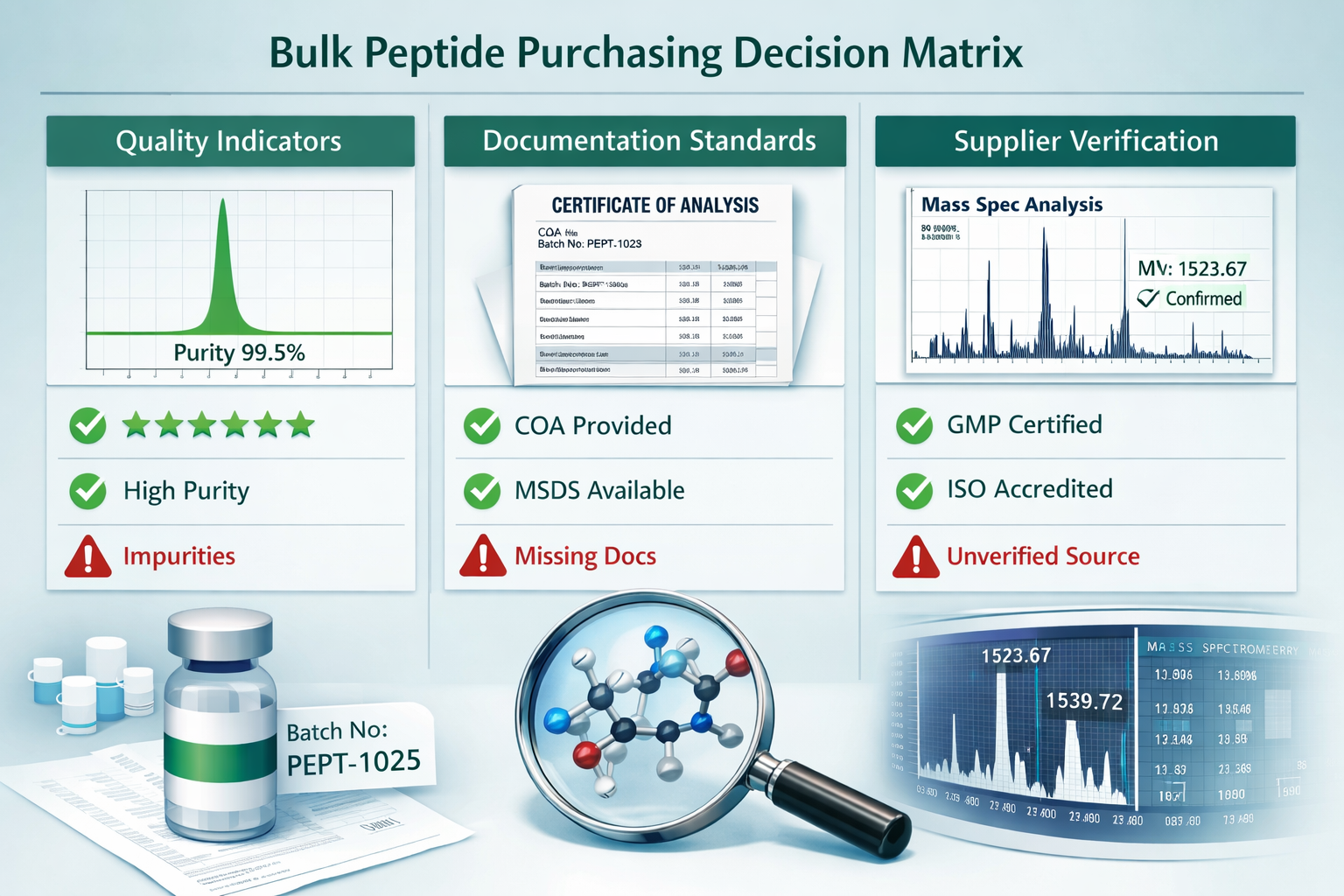
Gauging peptide purity is usually finished with analytical high-performance liquid chromatography (HPLC), typically paired with mass spectrometry (MS) for identity verification. These logical strategies are typical in peptide quality assurance and you will generally obtain HPLC and MS information with a research study peptide order. The primary logical techniques for peptides include fluid chromatography (LC), normally HPLC, integrated with mass spectrometry (MS) for precise molecular weight determination and series validation.
Types Of Pollutants Hplc Identifies
A strong test report can sustain pureness, identity, and set traceability. It does not transform a study substance right into a clinical item, and it does not replace speculative recognition in the researcher's very own system. Peptide pureness isn't just a number on a tag-- it's a home window into the quality of the synthetic process and a predictor of how trusted your research results will certainly be. At Ethos Analytics, we provide specialized peptide testing and quantitation services to sustain study, pharmaceutical, and nutraceutical applications. Our research laboratory utilizes state-of-the-art instrumentation and validated approaches to make certain precise, reproducible information across even the most complex peptide matrices. William is a research study analyst at Peptides Laboratory UK, being experts in study peptides, lab compounds, and sourcing requirements for high-purity peptide products.
The gold standard for measuring peptide pureness is high-performance liquid chromatography, generally abbreviated as HPLC. If you see a purity percentage on a peptide product, it likely originated from an HPLC evaluation. This matters because peptides are built one amino acid each time via solid-phase peptide synthesis (SPPS). At each step, there's a small opportunity that Peptide Blends something goes wrong-- an amino acid does not affix, the incorrect adjustment occurs, or a side reaction produces an unplanned byproduct. Over a chain of 10, 20, or 40 amino acids, those tiny per-step error prices compound.
Peptide screening is the collection of analytical checks utilized to assess a peptide sample prior to it is made use of in a research operations. In useful COA evaluation, the term typically refers to pureness screening, identification screening, and documents review. Purity testing asks just how much of the discovered sample is the main peptide versus relevant impurities. Identity testing asks whether the determined mass or sequence-related proof matches the designated peptide. Paperwork review asks whether the record is batch-specific, deducible, and outlined sufficient to be audited. Peptide screening is the logical procedure utilized to confirm that a research peptide is both pure and appropriately determined. BOC Sciences, with its robust analytical system and professional team, concentrates on quality testing services for peptide resources, peptide microspheres, peptide nanoparticles, and peptide solution preparations. We collaborate with biotech, pharmaceutical, CRO, CDMO, and scholastic teams on peptide chemical and physical evaluations that sustain research and non-clinical choice making. Get in touch with us today to discuss your peptide sequence, example condition, and analytical purposes.